Search This Blog

Friday, 5 October 2012

The (Thai) Beauty Myth


   Why do so many Thai women fall for the whitening cream scam?
We all know that the world is full of scams, scammers and the scammed. It’s a fact of life like knowing you’re going to fall down the first time you ride a bike, or that your first swig of beer will taste disgusting. The most famous of these scams is the Nigerian scam which is apparently so successful that it actually affects Nigeria’s GDP figures. As a man, it never ceases to amaze me how easily women are fooled into believing the obvious scam that certain creams on the market will make their skin whiter. It’s so obviously a scam yet there are so many women who fail to be deterred and go out and buy the products. Men are increasingly doing the same. On a kind day we might call it simply gullible; - what the Thais call hoo bow ("light ear"); on another we might want to call it the “Michael Jackson” syndrome. But let’s be honest - we can’t blame anyone for this because all advertising works on the same premise. Like Hitler’s henchman, Joseph Goebbels, said, “If you tell a lie often enough, sooner or later, people will start to believe it”.

   A whiter shade of pale?
It cannot have escaped many people’s attention in the last few weeks this Thai preoccupation with whitening creams and various other toiletry accessories that purportedly make you look whiter than white or, as the song goes, a “whiter shade of pale”. Thai TV serves up a less than healthy dose of advertisements on a daily basis: creams that have a variety of applications e.g. to cure pimples and black spots, to enrich your skin with vitamins, to give nourishment to your face, to bleach your vagina and, most important of all, to make your skin look whiter. Indeed if you read any of the ads for these Chinese made products, you’ll laugh so hard the blood will drain from your face and produce the desired effect without you having to shell out one baht.
Apparently, according to OEM Whitening Cream, if you use one of these products, your face will be “withened charmingly”. Umm…can’t wait to try it. In another ad for Pearl Whitening Cream, we are informed of the following effects: “The glucosamine clear white compount, the coordinate nanometer pearl pure whitening strength may a depth of the skin most in level…causes the flesh shining white to be exquisite, high resilience, brilliance according to human.” There you have it – as clear as a baby’s talc splattered bottom. The only question now is how many do you require?

  Passing fad or deeper cultural malaise?
               But, joking aside, it’s tempting to see this as just a passing fad: something that will go away in the same way that the Rubix Cube and Pogo Stick did. After all, most people like to change their skin colour from time to time. Westerners from colder European climates will lie on a sun bed or sunbathe in order to get a tan. It’s not healthy, but it’s understood why people do it. Thai youngsters and Thais in general are keen to look good, too. They are also very advertisement savvy and always want the latest gadget or new thing on the market, so it could be that using whitening creams is just another extension of wanting what’s “hot off the press” like a new I-phone or a new hairstyle and, when the next “new thing” comes along, vagina and other skin creams will all be forgotten.
Clearly the authorities are unfazed by this. Deputy permanent secretary for the Mental Health Department, Dr. Thawee Tangseree, said the following on 24 September 2012,

“This white skin business is just a fad that comes and goes. Soon it’ll be replaced by other fads. Now it’s not just women who pay attention to white, shining skin. The men are also starting to adopt the same value and want the Korean-style white skin as well…”

He’s right too as Thai men, never too far behind the fairer sex, are getting in on the metrosexual look with products for whitening deodorants and products that whiten the armpits. Only yesterday, in a branch of Carrefour in Riyadh, I spotted, side by side, both men and women’s whitening cream (see photo below) so it’s clear that advertisers are not only targeting Thai men, but men of other races and cultures as well.

SaudiWhiteningCream2
When enough is enough
Along with these whitening creams there has recently arrived a cream that will apparently make your vagina whiter, too so there appears no place where the body is sacred nor any end to the production line of products entering the Asian beauty market. But is this indicative of a nation where the power of advertisers is too high, or are the advertisers merely responding to demand? Louis-Sebastien Ohl of Public is Thailand, the company responsible for creating the advert for vagina whitening cream had this to say
“Now an intimate toiletry also offers a whitening benefit, because research evidenced that … women [are] keen to have such a product.”
 But is it really true that women are keen to have such a product, or is it something of a chicken and egg conundrum? Is the demand for these products out there because advertisers have bombarded young impressionable Thais with them, or is it just a logical extension of areas previously catered to: armpits, skin, body, face? In other words, is the vagina the last untouched area hitherto free from the advertisers’ clutches?
Critics of the trend for skin whitening, such as Bangkok Post journalist Kultida Samabuddhi, have argued in “Feminine white wash goes too far” that such products have changed the country's value system. http://www.bangkokpost.com/opinion/opinion/312264/feminine-white-wash-goes-too-far
“When a feminine cleansing product was first introduced in Thailand several years ago, a debate took place on whether such a product was necessary. Doctors concluded that it was not necessary and that mild soap, or even pure water, is enough to clean a woman's intimate parts. However, manufacturers and advertising agencies have worked tirelessly to convince consumers that the intimate wash product is a must-have.”
Kultida is adamant that it is the advertisers themselves who have shifted the beauty debate to ensure that women feel the need for their products:
“As the definition of beauty has been changed by the cosmetic industry, Thai women who fail to meet the beauty standards set by cosmetic producers and ad agencies have to struggle very hard to maintain their self-esteem," she told the Guardian.” This chimes with Naomi Klein’s view in her book, The Beauty Myth, that as women have gained increased social power and prominence in society, they are expected to adhere to ever increasing standards of physical beauty.
In other words, translated into a Thai context, young aspiring Thai women who want to climb the corporate ladder are held to a different set of standards. While men are judged primarily on intelligence, leadership and management skills, young Thai women are judged almost exclusively on their looks. Anyone who doubts this need look no further than any one of the multitudes of office buildings in Bangkok any given lunch time or at 5pm closing time to see the office girls or “pretties” that throng the stairways and elevators.

Doesn’t matter if you’re black or white…
Clearly this has stirred up a debate about why Thais, other than as I said, for career reasons, want so much to be white. Kate Hodal wrote the Guardian article which is largely responsible for starting this debate off. She reminds us about the ways in which colour has been portrayed in Thai language. 
In many countries across south-east Asia, fairer skin is equated with higher class as it suggests a life not spent toiling in rice paddies under the sun. The Thai language is peppered with expressions that denigrate dark skin, such as the insult dam mhuen e-ga – "black like a crow". These days, rice farmers wear long sleeves, trousers, wide-brimmed hats and gloves. According to DRAFTFCB, the agency behind many of Nivea's skin-lightening ads in Thailand, such labourers make up much of the Thai market for Nivea's face- and body-lightening products.Thailand’s Vaginal Whitening Wash http://www.guardian.co.uk/world/2012/sep/23/thailand-vaginal-whitening-wash
Kaewmala, a Thai researcher and writer, shows how deeply ingrained this notion of colour is in Thai culture and depicted in art and drama.
Thai classical literature is full of heroes and heroines who are beautiful and have ‘golden’ skin (though not always literally), and bad guys and gals who are ugly and ‘black’ (dark). Black skin and black heart vs. Golden skin and good heart. The good guys and gals have bright auras. Their skin ‘glows’, exuding beauty and goodness, so on and so forth. These days on Thai television, in film, or on stage, you are hard pressed to find any dark-skinned heroes and heroines. In fact, even the bad guys and gals are now fair-skinned. Heck, now that everyone has access to skin whitening products, we don’t get the color-coded cue in the story anymore!” Thailand’s skin whitening craze: How low will it go? http://asiancorrespondent.com/90046/thai-craze-for-white-skin-how-far-does-it-go-and-where-will-it-end/
Having lived in Thailand for most of the last 15 years, I can say that one of the first things I noticed when I arrived was the inherent racism that expresses itself in the coffee shops and bars from Sukumvit Road to Silom and back. I’ve seen it in my classrooms as well posing as lively banter but almost always expressing a firmly held belief that the darker your skin, the less value you are to society. References almost always go hand in hand with allusions to kwai (buffalo), denoting stupidity, and suggestions that person must come from Laos, again denoting stupidity and dark skin. This raises a serious question – where do these youngsters get such negative ideas about colour and race?
I remember once seeing an advertisement on TV in Thailand for a white soap where the two main characters were a small, very white skinned, young Chinese-Thai looking girl who refused her mother’s request to wash her face, and a big black African guy who could’ve passed for the imprisoned black man in The Green Mile (played by the recently deceased, Michael Clarke Duncan). The message was clear in how the mother berated the young child telling her that she’d end up like the African guy if she didn’t use the white soap. This kind of overt racism is endemic in Thailand and, in more developed countries, such an advertisement would not even be allowed to be aired. But in Thailand it is indicative of the power of the advertisers and the way in which they can set the standards for the rest to follow.
What this also tells you about Thailand is that because advertisers enjoy such power, they do, as journalist Kultida Samabuddhi suggests, change the rules about beauty or at least have a very strong influence on the kinds of beauty products that both Thai men and women buy. Whether regular whitening cream or vaginal cream are fads or here to stay in the long run, is anyone’s guess. But one thing is for sure: such creams do no more than change the surface look of your skin using a bleach-like chemical substance and, as such, they are only temporary, not permanent. Therefore, whatever colour Mother Nature made you, is the one you’ll take to your grave, and that’s something not even the advertisers, as powerful and convincing as they are, can change.

Tom Tuohy is a teacher and writer. He has written for a number of newspapers, magazines and websites including: The Guardian Weekly, the EL Gazette, jobs.ac.uk, The Bangkok Post, and UniversityWorldNews.com You can order his book, Watching the Thais, here
========================================================

Tuesday, 25 September 2012

"Watching the Thais" is on sale now!!!

Finally, my book about living and working in Thailand is finished and available to buy. Here's the link: http://www.feedaread.com/books/Watching-the-Thais-9781781766699.aspx


At the moment, it's only available on feed-a-read.com and it will be on Amazon and others very soon. It will also be available in digital format, probably the kindle (when I can figure out how to convert it!) and then I am also working on a local printing (in Thailand) in English and also a translation into Thai so that remains an option for some people as well.

But for now, it's here to buy at a very reasonable price.


Tuesday, 18 September 2012

Foreigners slammed for lopping trees

Ordinarily words would fail me, but in this situation, three words really do now spring to mind: "kettle", "calling" and "black". How many times have we heard of Thais lopping down not just a few trees, but whole swathes of forest in places like Khao Yai and Pak Chong but to name two areas? And the reason for this mass culling of nature's garden? To build new homes and especially high end resorts to attract high spending customers. Not a thought at all for the pernicious effects of this on the environment.

Now we are told that many Thais are indignant because they saw some foreigners on Koh Phangan island doing something as minor as cutting down one inconveniently placed tree to help with their business. "Hypocrisy" is another word that could be easily added to this list.

Here's the article from The Bangkok Post:

"A group of about five foreigners have been caught on camera lopping a large branch off a tree on Phangan island and have been heavily criticised by Thai netizens, many of whom demanded that the authorities arrest them.
Photographs of the foreigners cutting off the tree branch on the popular tourist island in Surat Thani were posted on Sept 15 on Pantip.com, a popular internet forum, by a person who went by the name of vuddiken. The link is www.pantip.com/cafe/blueplanet/topic/E12655715/E12655715.html.

 
 Foreign tourists sunbath on Phangan island of Surat Thani province. (Photo by Supaphong Chaolan)
The topic of the discussion thread is "A group of inherently bad foreigners on Phangngan island in pursuit of their self-interested business surreptitiously chopping down a tree to open a paragliding business."
However, the original poster did not specify when the incident happened.
One netizen said the group of foreigners should not have cut off the tree branch and asked if the tree was in a private or public area or if it was in a national park.
Many posters called on authorities, including National Parks, Wildlife and Plant Conservation Department director-general Damrong Pidech, to track down these people and take legal action against them.
Thirayuth Plaisuwan, chief of tambon Bantai in Phangan, said he had been informed about the incident and will check whether the area was in a national park.
If the tree is public property, police will definitely find those responsible for the damage and take action against them, Mr Thirayuth said."

This is something that reminds me of when I first went to Thailand some fifteen years ago. I regularly used to hear opinions such as that the reason places like Nana Plaza and Patpong exist is only because of the foreigners who frequent them and that there are no bad girls or prostitutes in Thailand. It never occurred to the person opining this that it's Thais who own such business and that the country is replete with prostitution and many other unsavoury professions.

It seemed to me at the time that foreigners were always being blamed even for things that they had nothing to do with and in fact were 200% controlled by Thais. Perhaps it's a face saving mechanism or perhaps Thais realy do believe that foreigners are the source of everything bad in Thailand. Who knows!

Source: http://www.bangkokpost.com/news/local/312918/foreigners-slammed-for-cutting-tree

Monday, 17 September 2012

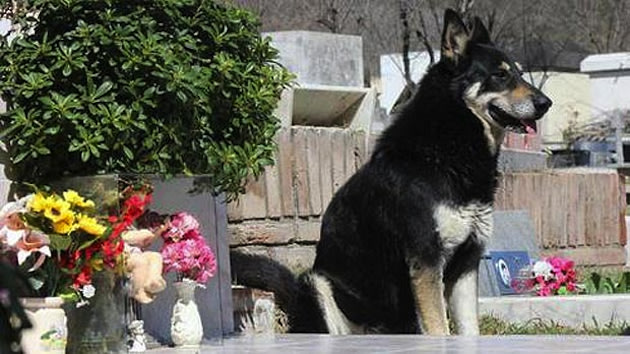
Dog stands guard over deceased owner’s grave for six years

What a truly heartwarming and amazing story of true love and unbounding loyalty! This is why dogs are called man's best friend. The funny thing is that when the dog's owner died, the dog was never even at the funeral site so how did he find it and how did he even find the grave? There's so much more to animals, especially domestic animals, than we realise.

I'm quoting the story in full below because it's the kind of story that will brighten your day of even the most obdurate of people!


Capitan keeps watch over Miguel Guzman's grave (La Voz)An extremely dedicated dog has continued to show its loyalty, keeping watch on its owner's grave six years after he passed away. Capitan, a German shepherd, reportedly ran away from home after its owner, Miguel Guzman, died in 2006. A week later, the Guzman family found the dog sitting by his grave in central Argentina.
Miguel Guzman adopted Capitan in 2005 as a gift for his teenage son, Damian. And for the past six years, Capitan has continued to stand guard at Miguel's grave. The family says the dog rarely leaves the site.
"We searched for him, but he had vanished," widow Veronica Guzman told LaVoz.com. "We thought he must have got run over and died.
'The following Sunday we went to the cemetery, and Damian recognized his pet. Capitan came up to us, barking and wailing as if he were crying." Adding to the unusual circumstances, Veronica says the family never brought Capitan to the cemetery before he was discovered there. "It is a mystery how he managed to find the place," she said.
Cemetery director Hector Baccega says he and his staff have begun feeding and taking care of Capitan.
"He turned up here one day, all on his own, and started wandering all around the cemetery until he eventually found the tomb of his master," Baccega said.
"During the day he sometimes has a walk around the cemetery, but always rushes back to the grave. And every day, at six o'clock sharp, he lies down on top of the grave, stays there all night."
But the Guzman family hasn't abandoned Capitan. Damian says the family has tried to bring Capitan home several times but that he always returns to the cemetery on his own.
"I think he's going to be there until he dies, too. He's looking after my dad," he said.

Friday, 14 September 2012

Those Boys in Brown are up to no good again!

 This is the story on Thaivisa.com courtesy of Richard Barrow's website...

Thai police applicants told they cannot have genital implants or try to enlarge them

Posted Image

BANGKOK: -- There has been a lot of news recently of cheating going on for police entrance exams in Thailand. During the recent exams, everyone had to submit themselves to a pat down and go through a metal detector.

Now comes news that many people were disqualified from even taking the exams as they failed medical examinations at the Police General Hospital. I presume all of the usual contagious diseases were tested for, but according to the Bangkok Post, many people were disqualified for having tattoos on their body parts.

I didn’t realize that was true for police officers, but I do know that people applying for office work will have to make sure that they don’t have any visible tattoos.

What was even more surprising is that, according to a police spokeswoman of the Royal Thai Police Office, applicants who failed the health checks also included many who had injected paraffin gel into their genitals, and those that had their genitals implanted with small beads.

I am not sure how that would affect their job as this kind of thing has been going on for years in Thailand.

Full story: http://www.richardba...nital-implants/

Sunday, 5 August 2012

MP calls for ban on tattooed preacher who 'cures' cancer by kicking people in the face

There really are some wacky people out there! Today it was revealed that an evangelist who kicks followers in the face, claiming his violence will cure them of cancer, is to tour Britain this month. Do people like this really exist? It's enough for an evangelist to wheedle money out of unsuspecting victims (we've all seen the Steve Martin movie about such con men) but this is quite a step up to actually being physically assaulted at the same time!

Violent: Canadian preacher Todd Bentley with a follower at one of his 'healing' shows in which he kicks people in the face, claiming it will cure them of cancer

Unsurprisingly, this evangelist's proposed visit has provoked outrage and demands that he be banned from entering the country. Tattooed preacher Todd Bentley,  who as a 15-year-old was convicted of a sex attack on a boy aged seven, claims God uses him as an instrument to heal the sick, and is urging the frail to attend his shows. 

The former drug user, who is Canadian but based in the United States, even laughs about his ‘healing’  techniques. In one show he treated a man claiming to be suffering from colon cancer by planting his knee hard into the victim’s stomach. The man fell to the floor in agony.
 
Two questions naturally spring to my mind. Why would anyone, especially someone with an incurable illness, pay money to have themselves physically assaulted and thus hurt in order to rid themselves of this disease? And, secondly, who but a complete nutter would charge for such a service and laugh while administering it? The mind boggles sometimes, it really does!

Read more: http://www.dailymail.co.uk/news/article-2183860/MP-calls-ban-tattooed-preacher-cures-cancer-kicking-people-face.html?ITO=1490

Cows also 'have regional accents'


You couldn’t make this stuff up! I blogged about goats before that can have accents relative to where they were brought up and their own peer groups. Apparently, cows also have regional accents like humans, language specialists have suggested. They decided to examine the issue after dairy farmers noticed their cows had slightly different moos, depending on which herd they came from. 


John Wells, Professor of Phonetics at the University of London, said regional twangs had been seen before in birds. The farmers in Somerset who noticed the phenomenon said it may have been the result of the close bond between them and their animals. Farmer Lloyd Green, from Glastonbury, said: "I spend a lot of time with my ones and they definitely moo with a Somerset drawl.


"I've spoken to the other farmers in the West Country group and they have noticed a similar development in their own herds. It works the same as with dogs - the closer a farmer's bond is with his animals, the easier it is for them to pick up his accent."

Prof Wells felt the accents could result from their contemporaries. He said: "This phenomenon is well attested in birds. You find distinct chirping accents in the same species around the country. This could also be true of cows. In small populations such as herds you would encounter identifiable dialectical variations which are most affected by the immediate peer group."

Dr Jeanine Treffers-Daller, reader in linguistics at the University of the West of England in Bristol, agreed that the accent could be influenced by relatives.She said: "When we are learning to speak, we adopt a local variety of language spoken by our parents, so the same could be said about the variation in the West Country cow moo."

Umm...I'm now wondering what London cows sound like or cows from Northern ireland?

Fresian 1: Alright Dave, that there patch a grass is a bit sinewy. Try some furver up by da fence.
Fresian 2: You're 'aving a laugh int ya? tried it yesterday guv - tastes like nat's piss!


Source: http://news.bbc.co.uk/2/hi/5277090.stm